
As a shipper, when you think about freight distribution in the Western US, you’re likely drawn to the major hubs of Los Angeles, Oakland, and Seattle.
But a little further East, Denver may be just the location your supply chain needs as an operating base for over-the-road (OTR) capacity.
You can reach approximately 28% of the total US population (about 95.5 million people) within 2 days via OTR trucking, while also enjoying significantly lower costs and less port-area congestion than the more popular hubs listed above.
In this article we explore the advantages of running a Western distribution hub and how a Denver fleet can give shippers reliable, controllable capacity across the Mountain West.
Acme Distribution is a Denver-based asset carrier and 3PL, running company trucks and drivers on the Front Range for 80-years. We also run brokerage operations extending coverage into the Pacific Northwest and Mid-Atlantic. This article draws on what we’ve learned running that operation day-to-day.
Thinking about adding Denver to your distribution network? Not sure where to start? Talk to our team about your lane mix and together we’ll figure out if a Denver Distribution Hub is the right move for you.

When does Denver make more sense than other Western logistics hubs?
Denver tends to make the most sense when a company wants balance instead of pure port proximity.
If your network is heavily import-driven and every priority starts with getting containers close to a port complex, a coastal hub may still be the better answer.
But that is not every shipper.
Denver often makes more sense as a logistics distribution hub when:
- your volume is moving into inland Western states, not just the coast
- you want to reduce reliance on one Southern California node
- you need one regional hub that can support pallet flow across multiple states
- your business is more affected by service stability and routing flexibility than by being closest to the port
- you are trying to balance transportation cost, transit time, and inventory position across a broader region
This is especially true for mid-sized manufacturers, distributors, and retail suppliers with repeat pallet volume, that balance can matter more than simply being closer to a port.
The question is not just where you can store inventory. It is where you can position inventory to support customers efficiently without creating unnecessary transportation or service challenges.
That is where Denver can outperform a coastal-only model.
Why does Denver’s location improve transit times and shipping flexibility?
Denver tends to make the most sense when a company wants balance instead of pure port proximity.
If your network is heavily import-driven and every priority starts with getting containers close to a port complex, a coastal hub may still be the better answer.
But that is not every shipper.
Denver often makes more sense as a logistics distribution hub when:
- your volume is moving into inland Western states, not just the coast
- you want to reduce reliance on one Southern California node
- you need one regional hub that can support pallet flow across multiple states
- your business is more affected by service stability and routing flexibility than by being closest to the port
- you are trying to balance transportation cost, transit time, and inventory position across a broader region
This is especially true for mid-sized manufacturers, distributors, and retail suppliers with repeat pallet volume, that balance can matter more than simply being closer to a port.
The question is not just where you can store inventory. It is where you can position inventory to support customers efficiently without creating unnecessary transportation or service challenges.
That is where Denver can outperform a coastal-only model.
How does I-25 and I-70 make Denver a practical distribution point?
Denver’s value is not just that it is inland. It is that it sits on two corridors that matter.
I-25 gives a straight north-south spine through the Front Range. I-70 gives an east-west corridor that connects Denver into broader inland freight flows. Together, they make Denver a practical handoff point for regional distribution and a workable position for national routing.
Good corridor access affects trailer turns, dispatch timing, route planning, and how much cushion a warehouse has when loads don’t move exactly as planned. If a truck misses its original schedule, a good corridor network gives the team more ways to recover without breaking the rest of the day.
That is especially important when you are working around:
- retailer appointment windows
- same-day shipping cutoffs
- pallet staging limits on the dock
- live unload schedules
- linehaul departures that do not wait for a late pick
Despite providing you a better operating base, strong highway access does not remove all execution risk.
Simply put: I-70 is an asset, but westbound mountain freight can get ugly fast when weather turns.
Snow, chain requirements, and pass conditions can change what looked like a clean plan a few hours earlier.
That is why smart retail distribution never relies solely on geography.
It relies on planning. It depends on dispatch discipline, backup carrier options, realistic appointment setting, and a warehouse team that knows how to adjust pick timing when transportation gets squeezed.
Acme’s Denver team plans around this every winter. Realistic appointmeent setting, and a warehouse team that knows how to adjust pick timing when transportation gets squeezed.
What 5 operational tradeoffs should you evaluate before choosing Denver?
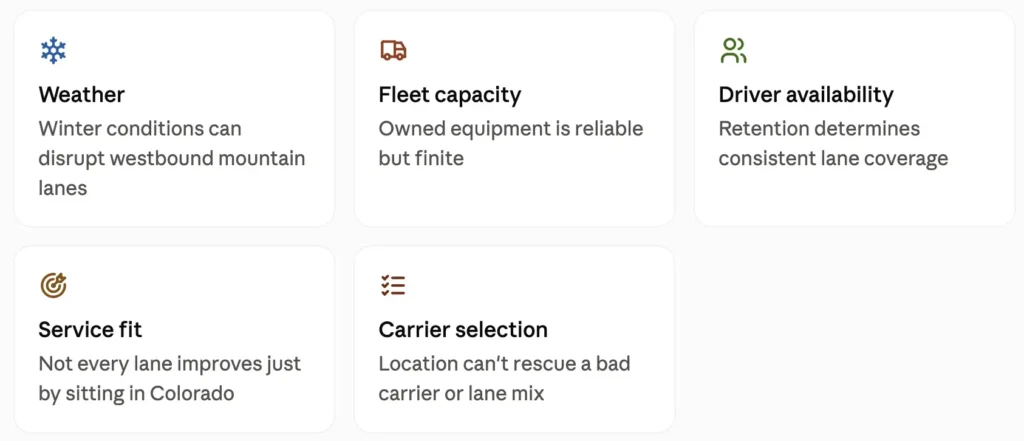
Denver has real strengths. It also has real constraints.
1. Weather
Winter conditions can disrupt inbound and outbound timing, especially on mountain lanes.
If your freight plan depends on tight westbound schedules through difficult weather, you need a carrier that plans around that risk rather than getting surprised by it.
Acme Distribution has an indoor rail spur, which means freight can be loaded, unloaded, and staged without sitting exposed to snow, ice, wind, or other elements.
2. Fleet capacity
Owned equipment is reliable but finite. Every asset-based carrier hits a ceiling, the real question is, what happens to your freight when volume outgrows it? Carriers with brokerage capability behind their fleet can flex vetted outside capacity into the gap; carriers without it either turn freight away or degrade service trying to force it through.
3. Driver availability
The Front Range gives access to a strong regional driver pool, but that access isn’t unlimited, and it’s shared across every carrier operating in the market. Driver retention is what determines whether your lanes get consistent coverage during peak demand rather than a rotating cast of new hires just learning the route.
Acme doesn’t run a driver shortage, because we don’t run our drivers the way carriers with a shortage do: our Denver drivers are guaranteed home daily routes so they can spend evenings with their families, every week. That single commitment is a bigger driver of retention than pay alone. Drivers stay because the job doesn’t cost them their weekends and that loyalty is what keeps the same drivers on your lanes month after month.
4. Service fit
Not every outbound lane improves just because freight sits in Colorado. That is why you should pressure-test a few practical questions before making a move:
- Where are your actual customers by volume, not by assumption?
- Are you trying to improve cost, speed, flexibility, or risk balance?
- Do you need a Denver-only model or a Denver-plus-coast model?
- Are your biggest problems tied to long-haul dependence, missed cutoffs, storage pressure, or weak carrier coverage?
- Will this move reduce chaos on the dock, or just shift the chaos to a different location?
5. Carrier Selection
A good location helps, but it can’t rescue a bad carrier or a bad lane mix. The strongest Denver-based partners combine dedicated equipment with the discipline and coverage to back it up when things don’t go as planned. That’s the difference covered in the next section.
What separates a strong Denver-based trucking partner from the rest?
A Denver fleet only creates an advantage if the carrier knows how to use it.The strongest Denver partners usually have a few things in common:
- Dedicated capacity built around their home market. Trucks and drivers are positioned to consistently run the lanes they know best—not spread thin across every market.
- Dispatch discipline when things go wrong. Delays and schedule changes are part of trucking. The difference is whether dispatch has a clear recovery plan or is scrambling to solve problems in real time.
- Coverage beyond their own fleet. No fleet, regardless of size, can cover every lane a shipper needs. Carriers with their own brokerage network can extend coverage while keeping the relationship in-house instead of handing you off to an unknown carrier.
- Honest about where they fit. A carrier that will tell you when Denver-based capacity isn’t the right fit for a lane is more credible when they tell you it is. That kind of transparency builds trust.
Acme Distribution was built around that combination: with fleet and brokerage capabilities in Tacoma, Washington. and brokerage capabilities at our Harrisburg, Pennsylvania, operating as one coordinated network rather than two separate businesses.
If you’re evaluating Denver or another Western distribution hub, Acme Distribution can help you assess the options and determine what makes the most sense for your network.
If you’re evaluating Denver or another Western distribution hub, Acme Distribution can help you assess the options and determine what makes the most sense for your network.
Common Questions about Denver Trucking and Freight Distribution
Why is Denver a strong base for asset-based trucking?
Denver gives fleets and distribution operations inland access to the Mountain West and surrounding regional markets without relying solely on a coastal hub. Its position along I-25 and I-70 supports both north-south and east-west freight movement, making it a practical location for regional routing, dispatch, and distribution.
Is Denver a good location for Mountain West truckload capacity?
Yes. Denver can be a strong asset-based domicile when a shipper needs dedicated, reliable capacity into the Mountain West and nearby states rather than relying entirely on spot-market trucks sourced from elsewhere. It can also provide more flexibility than a coast-focused network when freight moves primarily through inland regional markets.
What makes a trucking company one of the top carriers in Denver, CO?
The strongest Denver carriers combine dedicated, asset-based capacity with disciplined dispatch, reliable service, transparent safety and on-time performance, and the ability to extend coverage beyond their own fleet. Many accomplish this through an in-house brokerage network that can cover lanes their assets cannot run.
Is Acme Transportation a good trucking company for Denver-based freight?
Acme Transportation operates an asset-based fleet domiciled in Denver, supported by brokerage operations covering the Pacific Northwest and Mid-Atlantic. Shippers with repeat truckload volume moving into the Mountain West are typically the strongest fit for Acme’s dedicated capacity. Shippers with broader, more complex, or import-heavy networks may benefit from combining Acme’s asset-based and brokered capacity.
How do I-25 and I-70 support freight movement in Colorado?
I-25 supports north-south freight movement along Colorado’s Front Range, while I-70 provides a key east-west corridor through Colorado and into broader inland freight markets. Together, they make Denver a practical location for dispatch, regional distribution, and transportation planning.
What industries benefit most from warehousing and distribution in Denver?
Manufacturers, distributors, retail suppliers, and pallet-based ecommerce businesses can benefit from Denver’s regional reach. The location is generally a stronger fit for companies with consistent freight volumes and repeat regional lanes than for operations with low-volume or highly scattered shipments.
When is Denver a better distribution point than Los Angeles or another Western hub?
Denver can be a better fit when the goal is inland regional reach, dedicated Mountain West capacity, and less dependence on a single coastal distribution point. Los Angeles and other coastal hubs may still make more sense when port proximity and import freight are the primary considerations.
Are there downsides to using Denver for asset-based trucking or distribution?
Yes. Weather and mountain-route disruptions, driver availability, labor competition, and finite fleet capacity can all affect operations. Denver is not a universal solution for every freight network. Its value depends on where a company’s customers, suppliers, and recurring freight lanes are located.